Brings the handoffs from several content-review stages together, so the
evidence for each item can be read, reported, and drawn as a whole. Give the
stages in the order they ran, such as an expert relevance panel and then an
item sort. Each stage can be a handoff from content_handoff() or a fitted
workflow, which is handed off with keep.
The result prints one row per item, with each stage's decision beside the statistic behind it, and it draws two figures for a paper or poster:
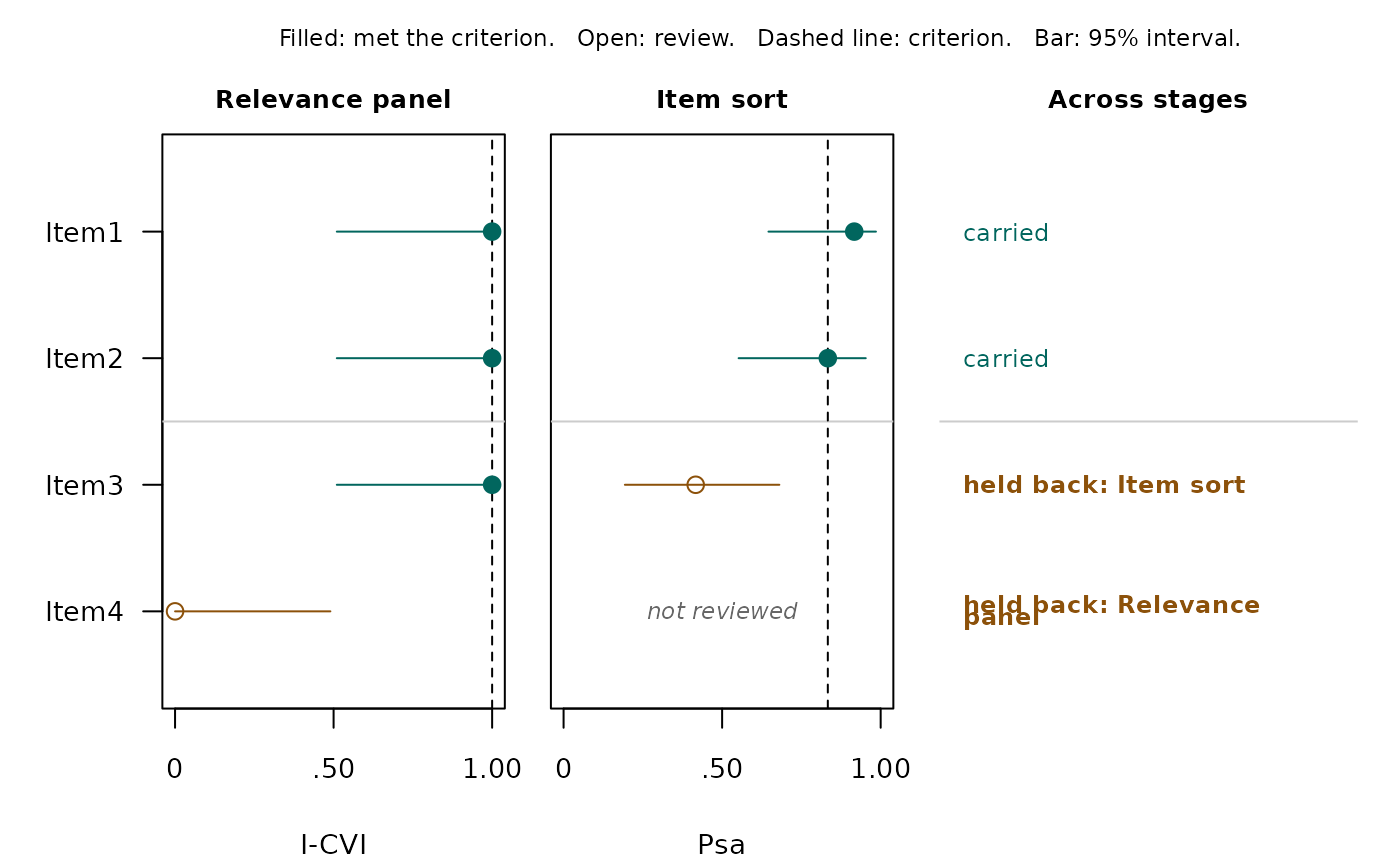
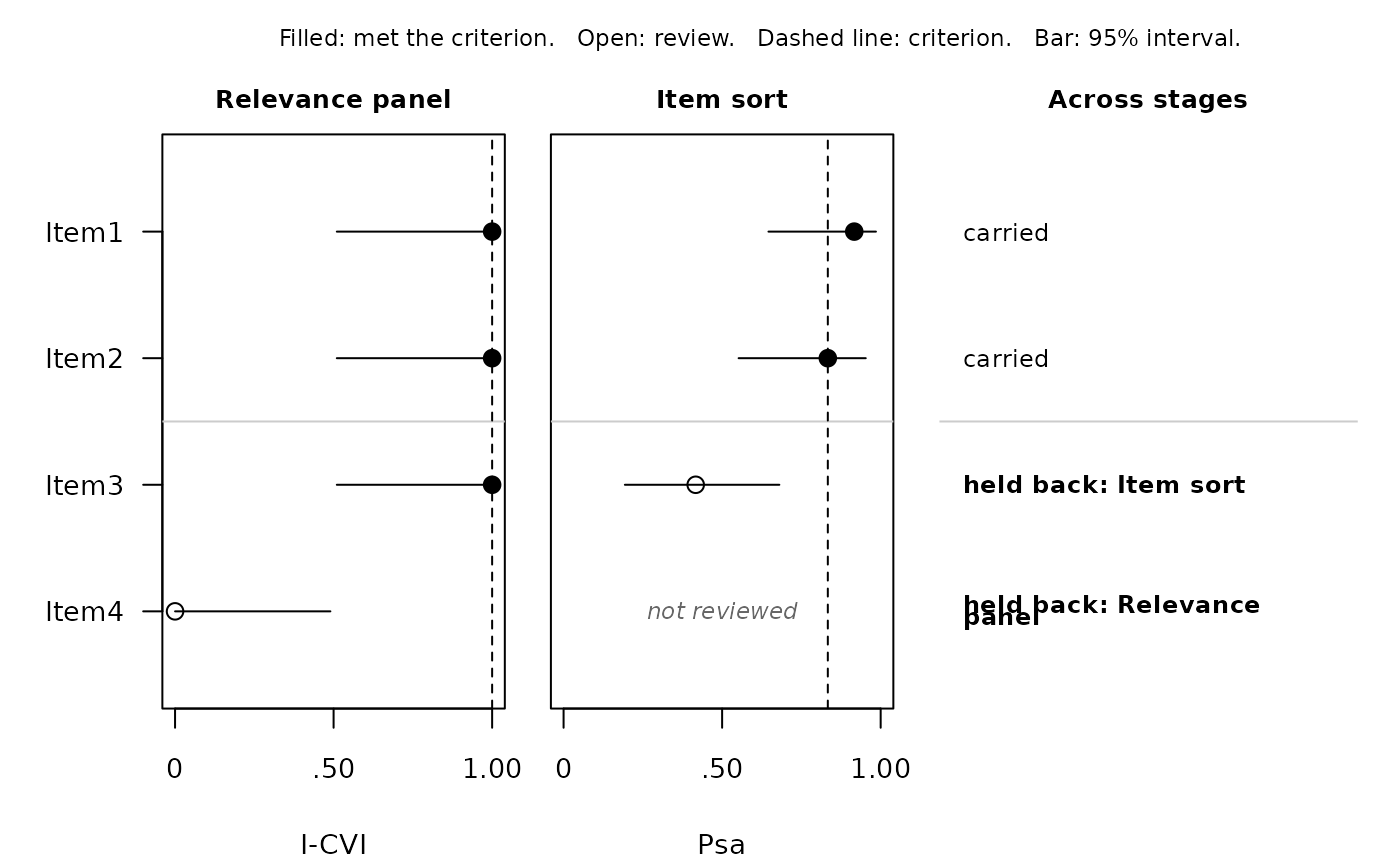
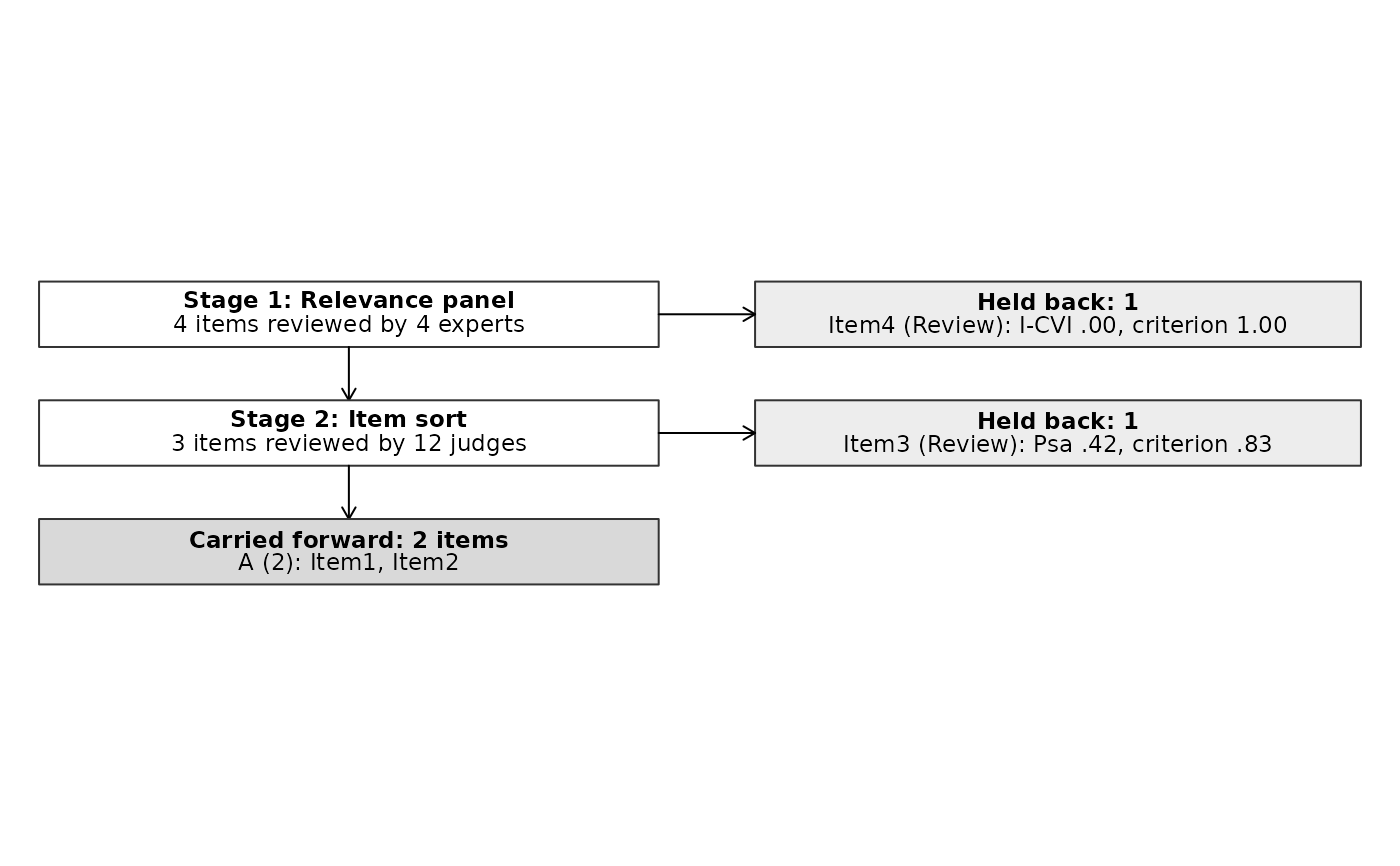
plot(x), the item evidence profile. One panel per stage shows the statistic behind each decision, its interval, and its criterion where the stage's rule has one, and a last column names the stages that held an item back.plot(x, type = "flow"), the item flow diagram. Each stage's box says how many items it reviewed, a side box lists what it held back with the number behind each decision, and the last box lists what was carried forward.
Arguments
- ...
Handoffs from
content_handoff(), or fitted workflows thatcontent_handoff()accepts, in the order the stages ran. Name them to label the stages, as incontent_evidence(Panel = h1, Sort = h2). Unnamed stages are labeled by their workflow. A stage cannot be labeled"item"or"result", which head the printed table's other columns.- keep
Statuses carried forward when a stage is given as a fitted workflow rather than a handoff, as in
content_handoff(). A handoff already records what it carried, sokeepdoes not change it.
Value
An object of class contentvalid_evidence, a list with:
stagesthe handoffs, named by stage.
itemsevery item reviewed, in the order first reviewed.
evidenceone row per item per stage:
item,scale,stage,statistic,value,lower,upper,level,criterion,recommendation,status, andcarried.as.data.frame()returns it.flowfor each stage, the items it reviewed, those an earlier stage had already held back, those it held back itself, those not held back so far that it did not review, and
decided, whether it applied a decision rule to any of its items.carriedthe items that at least one stage applied a decision rule to and that every such stage carried. An item no stage decided on is left out.
Details
The statistic each stage shows is the one its decision rule reads, taken from the handoff:
an item sort: Psa, against the exact test's criterion;
an expert relevance panel: the I-CVI, against Lynn's (1986) count (beyond ten experts, this package's extension holding her 7 of 9);
a Delphi study: the share of experts agreeing, against the consensus threshold;
an essentiality panel: the CVR, against the exact test's criterion;
congruence ratings: the index of item-objective congruence for the target objective, against the criterion, or the highest index when there is no target mapping;
construct ratings: HTC, with no criterion, because that workflow decides on its planned contrasts.
Decisions are read from each handoff, never recomputed from the statistic.
A congruence handoff made before contentvalidR 1.0 is refused, because its
"target IOC" holds a mean rating rather than the index; fit the panel again
with expert_validity() and hand that fit off.
Stages in sequence or side by side. Usually a stage reviews only what the stage before it carried forward, and the flow diagram reads that way. When two methods reviewed the same items side by side, a stage's box says how many of its items an earlier stage had already held back, and its side box lists only the items it held back itself. Either way, an item is carried forward when every stage that applied a decision rule to it carried it.
A stage holds back only the items it decided on. An item whose status
in a stage is "Descriptive only" was described there, not judged, as in a
Delphi study run without a consensus threshold or congruence ratings
without a target mapping. That stage's handoff does not carry the item, but
that is not a judgment against it, so here the stage does not hold it back,
even when it decided on its other items: a Delphi study without a threshold
still holds back an item it found to have too few experts. An item is
carried when at least one stage applied a decision rule to it and every
such stage carried it. An item that no stage applied a decision rule to is
neither carried nor held back: its result is "No decision", and carried
leaves it out. Its statistic is still shown. To carry such items on, hand
the stage off with keep = "Descriptive only" in content_handoff().
Where the displays come from
The flow diagram is modeled on the PRISMA 2020 flow diagram for systematic reviews (Page et al., 2021), with items in place of studies. The evidence profile is this package's own design. It sets out each stage's statistic as a forest plot does, one panel per stage, so that agreement and disagreement between methods can be seen item by item. Neither computes anything new: both draw the statistics and decisions the stages already made.
References
Lynn, M. R. (1986). Determination and quantification of content validity. Nursing Research, 35(6), 382–385. doi:10.1097/00006199-198611000-00017
Page, M. J., McKenzie, J. E., Bossuyt, P. M., Boutron, I., Hoffmann, T. C., Mulrow, C. D., Shamseer, L., Tetzlaff, J. M., Akl, E. A., Brennan, S. E., Chou, R., Glanville, J., Grimshaw, J. M., Hróbjartsson, A., Lalu, M. M., Li, T., Loder, E. W., Mayo-Wilson, E., McDonald, S., . . . Moher, D. (2021). The PRISMA 2020 statement: An updated guideline for reporting systematic reviews. BMJ, 372, Article n71. doi:10.1136/bmj.n71
See also
content_handoff() for a single stage, and
plot.contentvalid_evidence() for the two figures.
Examples
relevance <- matrix(
c(4,4,4,3, 4,4,3,4, 3,4,4,4, 2,2,1,2),
nrow = 4,
dimnames = list(NULL, paste0("Item", 1:4))
)
panel <- expert_validity(relevance, mode = "relevance", lo = 1, hi = 4,
agreement = "none")
# The sort reviews the three items the panel carried forward.
sorts <- data.frame(
item = rep(paste0("Item", 1:3), each = 12),
rater = rep(1:12, 3),
target_construct = rep(c("A", "A", "B"), each = 12),
assigned_construct = c(rep("A", 11), "B", rep("A", 10), "B", "B",
rep("B", 5), rep("A", 7))
)
evidence <- content_evidence(`Relevance panel` = panel,
`Item sort` = sort_validity(sorts))
evidence
#> <contentvalid_evidence> Content evidence across 2 stages
#> 2 of 4 items carried by every stage that reviewed them. Held back: Item3 (Item
#> sort), Item4 (Relevance panel).
#>
#> Stages, in order
#> 1. Relevance panel: 4 items, 4 experts. Shows I-CVI.
#> 2. Item sort: 3 items, 12 judges. Shows Psa.
#>
#> Item Relevance panel Item sort Result
#> Item1 1.00 Strong support .92 Retain Carried
#> Item2 1.00 Strong support .83 Retain Carried
#> Item3 1.00 Strong support .42 Review Held back: 2
#> Item4 .00 Review -- Held back: 1
#>
#> What these columns mean
#> I-CVI -- Item-level Content Validity Index. Share of experts rating the item
#> relevant, against Lynn's criterion for the panel size (beyond ten, this
#> package's).
#> Psa -- Proportion of Substantive Agreement. Share of judges who put the item
#> in the construct it was written for (0 to 1; higher is stronger).
#> Result -- Carried when every stage that reviewed the item carried it;
#> otherwise the numbers of the stages that held it back, as listed above.
#> A "--" marks a stage that did not review the item.
#>
#> Full definitions: contentvalid_glossary(). To hide this key:
#> options(contentvalidR.show_key = FALSE).
#>
#> See plot(x) for the evidence profile and plot(x, type = "flow") for the flow
#> diagram; add apa = FALSE for color.
plot(evidence)
 plot(evidence, type = "flow")
 plot(evidence, apa = FALSE)